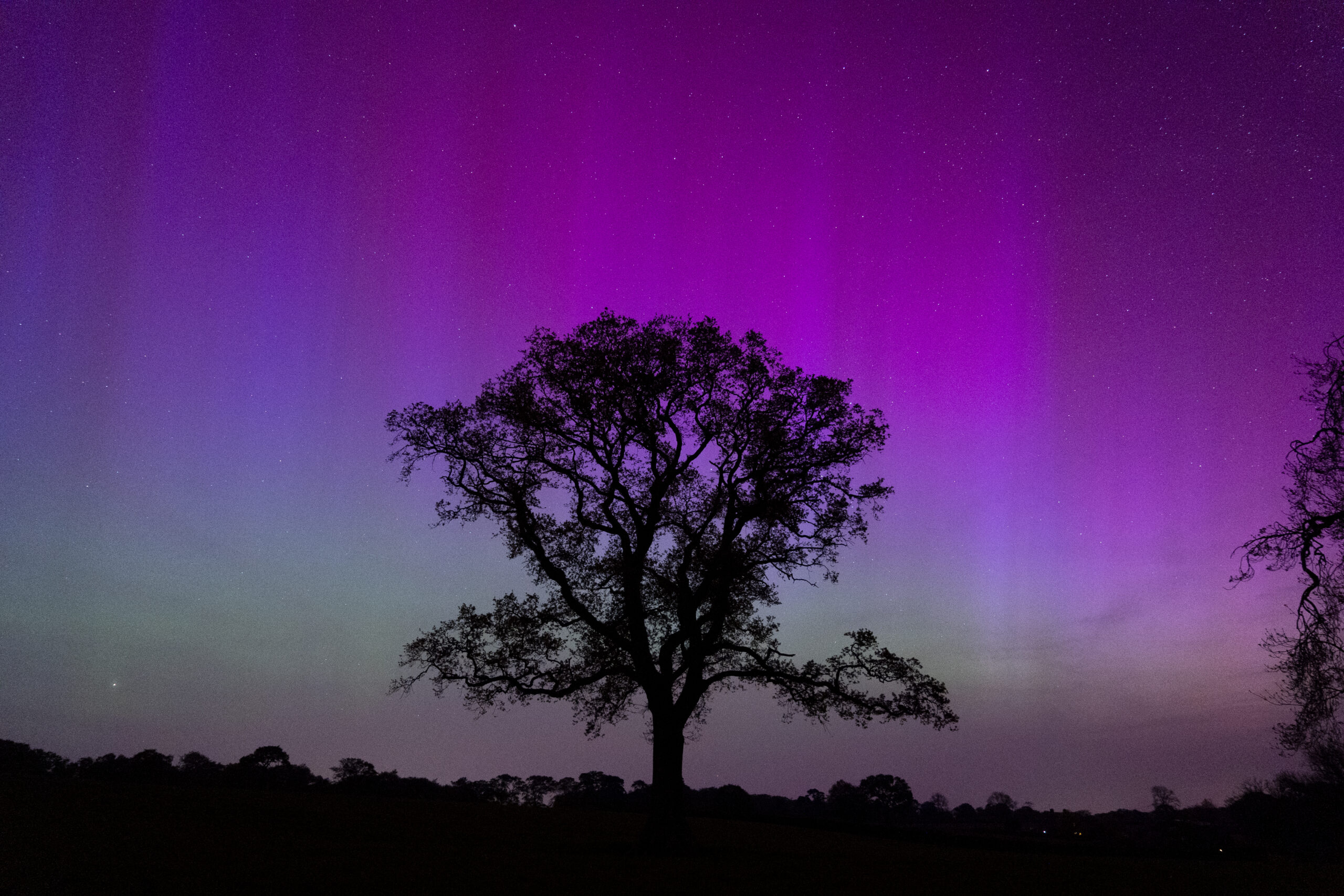

Right now we are in a peak period of auroral activity. In this post I give you tips and advice on how to maximise your own chances of seeing them!
Now first off I’m not an auroral physicist but I have been photographing the Northern Lights in England for the past 3 years and I have done a lot of research to maximise my chances.
Summary:
- What are the environmental conditions needed you need to look out for?
- Apps
- Location Tips
I don’t want to make this too complex to understand but these are the general things to understand to help you.
What Conditions Do You Need to See the Northern Lights?
Seeing the Northern Lights (Aurora Borealis) isn’t just about luck — it depends on a combination of solar activity, Earth’s magnetic field, and local viewing conditions. Understanding these factors can greatly increase your chances of spotting them.
When Are the Northern Lights Visible?
The Northern Lights are most commonly seen between September and March, when nights are long and skies are dark. Peak viewing hours are usually between 10pm and 2am, though auroras can appear earlier or later during strong activity.
What Causes the Northern Lights?
Auroras are created when solar wind — charged particles released by the Sun — travels toward Earth. When these particles collide with gases in our atmosphere, they release energy in the form of glowing light.
Earth’s magnetic field funnels these particles toward the polar regions, which is why the Northern Lights are most often seen in places like Norway, Iceland, Finland, northern Canada, and Alaska.
Understanding KP Index and Magnetometers
Many aurora forecasts refer to the KP index, which measures global geomagnetic activity on a scale from 0 to 9. While a high KP value can increase the chance of seeing the Northern Lights, it does not guarantee visibility.
This is because:
- KP is a global average and doesn’t show local activity
- Clouds, light pollution, and timing still matter
- Some strong solar storms move too quickly or unevenly to create visible aurora in your area
For more precise forecasting, experienced aurora watchers also check magnetometers. These measure real-time disturbances in Earth’s magnetic field and can indicate when auroral activity is actively occurring — often giving better short-term clues than KP alone.
Other Essential Viewing Conditions
Even with strong solar activity, you’ll need:
- Clear, dark skies – check moon phase
- Minimal light pollution
- A northern-facing view (in the Northern Hemisphere)
- Patience — auroras can fade and return quickly
Tip* – A high KP index is helpful, but the best aurora sightings happen when solar activity, magnetometer spikes, weather, and location all align. Checking multiple forecasts and being flexible with timing gives you the best chance of success.
Northern Lights Forecast Apps
Aurora forecast apps can look overwhelming at first, but once you know what each measurement means, it’s much easier to judge whether the Northern Lights are likely to appear. Here are the key indicators to look for — and what actually matters.
KP Index (Geomagnetic Activity)
The KP index measures global geomagnetic activity on a scale from 0 to 9.
- KP 3–4: Aurora possible at high latitudes
- KP 5+: Strong activity, aurora may be visible further south
Important: A high KP doesn’t guarantee visible aurora. It shows potential, not real-time activity, and doesn’t account for cloud cover or local magnetic conditions.
Bz (Magnetic Field Direction)
The Bz value is one of the most important — and most misunderstood — indicators.
- Negative Bz (southward) = GOOD for auroras
- Positive Bz (northward) = Poor conditions
A sustained Bz of -5 nT or lower allows solar particles to enter Earth’s magnetic field more easily, increasing auroral strength. Short negative spikes may not be enough — duration matters.
Solar Wind Speed
Solar wind speed measures how fast charged particles are travelling from the Sun toward Earth.
- Below 400 km/s: Weak activity
- 500–700 km/s: Strong aurora potential
- 700+ km/s: Very active conditions
Higher speeds mean more energy entering Earth’s magnetosphere, which often leads to brighter, more dynamic auroras.
Solar Wind Density
Density refers to how many particles are packed into the solar wind.
- Higher density = more fuel for auroras
- Sudden density increases can trigger auroral activity
Density works best when combined with high speed and negative Bz. On its own, it’s not a guarantee.
Magnetic Field Strength (Bt)
Some apps show Bt, the total strength of the interplanetary magnetic field.
- Stronger Bt (above ~10 nT) = more potential energy
- Works best when paired with negative Bz
Think of Bt as the amount of power available, while Bz controls whether that power can enter Earth’s system.
Magnetometer Readings (Local Activity)
Magnetometers show real-time disturbances in Earth’s magnetic field at specific locations.
- Sharp spikes or sustained movement = aurora is happening now
- Often more reliable than KP for short-term viewing decisions
If your app includes a local magnetometer, this is one of the best tools for deciding whether to go outside immediately.
Moon Phase (Often Overlooked)
Even strong auroras can be washed out by moonlight.
- New moon or crescent moon = best visibility
- Full moon = dim auroras may be harder to see
Bright auroras can still break through moonlight, but darker skies always improve contrast — especially for photography.
Final Tip: Look for Alignment, Not One Number
The best Northern Lights displays happen when multiple factors align:
- Negative Bz
- High solar wind speed
- Increased density
- Rising magnetometer activity
- Clear, dark skies with little moonlight
Rather than chasing a single KP number, successful aurora hunters learn to read the full picture.
Recommended Apps:
- SpaceWeather
- Glendale App
- AuroraWatch UK
- Hello Aurora (shows if anyone has reported a sighting in the area)
Some apps allow notifications but my best advice would be to follow Wil Photography on Facebook
He is very knowledgeable and has helped thousands of people see the northern lights on their doorstep. He also has a few channels that he sends messages on when he thinks there’s a chance of seeing the aurora.
Location Tips: Where to Look for the Northern Lights
Even during strong solar activity, where you are and which direction you look can determine whether you see the Northern Lights at all. Location, latitude, and sky conditions matter just as much as the forecast numbers.
Where to Look in the Sky
In the Northern Hemisphere, the Northern Lights usually appear:
- Low on the northern horizon during moderate activity
- Overhead or across the whole sky during strong geomagnetic storms
If you’re near the edge of the auroral zone (such as Scotland, northern England, or parts of northern Europe), you may only see a faint glow or pillars to the north, especially during weaker events.
How Bz Affects Where Auroras Are Visible
The lower (more negative) the Bz, the further south auroras can be seen, but with an important caveat.
- Slightly negative Bz (-2 to -5 nT):
Aurora mostly confined to high latitudes near the Arctic Circle. - Strongly negative Bz (-5 to -10 nT or lower):
More energy enters Earth’s magnetosphere, expanding the auroral oval and allowing auroras to be visible much further south than usual. - Positive Bz:
Even with high solar wind speed, auroras may remain weak or confined far north.
Key point: Bz controls how open Earth’s magnetic field is. A strongly negative Bz allows solar particles to penetrate deeper, pushing auroral activity toward lower latitudes.
However, Bz alone isn’t enough — solar wind speed, density, and duration must also support it.
Viewing by Latitude
- High latitudes (e.g. Norway, Iceland, Alaska):
Auroras are common; even modest conditions can produce visible displays. - Mid-latitudes (e.g. UK, northern Europe, northern US):
Require stronger storms, sustained negative Bz, and good timing. - Low latitudes:
Rare, only during extreme geomagnetic events with prolonged negative Bz and high solar wind speeds.
Dark Sky Tips (Crucial for Success)
No forecast can overcome poor sky conditions. For the best chance:
- Get away from city lights — even small towns can reduce visibility
- Avoid streetlights, car headlights, and nearby buildings
- Choose elevated viewpoints with a clear northern horizon
- Let your eyes dark-adapt for 20–30 minutes
- Use a red light or dim screen mode to preserve night vision
Final Location Tip
Strong auroras don’t always look dramatic at first. At lower latitudes they can appear as a pale grey or green glow before becoming brighter — especially noticeable through a camera.
Being in the right location, facing the right direction, under truly dark skies often makes the difference between seeing nothing and witnessing something unforgettable.
Oh and remember to wrap up warm!!
My next post will be on how to photograph the northern lights – keep your eyes peeled